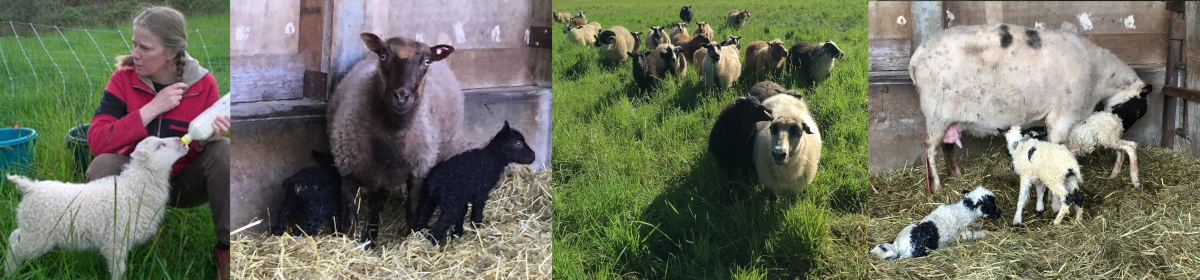
Icelandic sheep are one of the oldest breeds of sheep in the world. The Vikings brought them to Iceland around the year 1000. They have been isolated on the island since then and to this day are the biggest source of meat for Icelanders. Connoisseurs consider Icelandic lamb the best in the world and when you are used to the best you cannot accept anything else.
The Icelandic sheep were bred over centuries for a very practical purpose: to have good meat, good wool, good milk, good temperament and to be good mothers. Their genetic variation is huge. They come in a wide range of colors. Some are multi-colored and some are spotted. Both ewes and rams may or may not have horns. This makes every Spring (lambing season) an exciting time here on the farm as we anticipate the numbers and color variations of our flock.
Icelanders, who live away from their island, have a difficult time finding farmers raising Icelandic lamb in other countries. As they travel back and forth between Iceland and their adopted country, they often fill a suitcase or two with lamb before leaving the island.
We raise Icelandic lamb here, in the State of Washington, so there is no need to go 5000 miles for the best.
Our Sheep
We started off in 2001 with three sheep and a ram. But eventually settled into have having about 16 to 18 ewes and a ram. That is a good number for us. They all fit into the barn and as the ewes usually have two lambs each, the flock expands to about 50 animals each spring. Having spent many years on a farm in Iceland, Selma has a very particular way of raising the sheep. The basic principal is “give them everything they need and then leave them alone”. During the winter months they stay in or near the barn and are fed local hay. But as mid March approaches, they go out into the fields where they are moved to a clean pasture every few days. In late summer when our fields go dry we move them to the irrigated pastures at the dairy. It makes all the difference to have irrigated pastures. The sheep are moved from pasture to pastures until the rains start in the Fall, at which time they head back to the barn.
Our sheep, lamb out on pasture, weather permitting. It is the cleanest and most comfortable place for the ewes to have their lambs. In April during lambing season, Selma does not get a lot of sleep since she monitors the ewes every few hours in case one needs help. It is amazing how many births take place at night. As with any births, most of them happen without any problems, but it is good to be close by in case help is needed. Over the years we have had to pull a few and turn one that was coming out the wrong way, but most of the time Selma stays at a safe distance so the ewes can give birth to their babies in peace.
We take care of our pastures by fertilizing, harrowing and mowing when needed. From good healthy pastures come healthy animals. The only supplements we give our sheep are salt with minerals and Kelp. They have access to theses supplements at all times and take in as much as they need, which changes throughout the season and is not always they same.
Our animals do not receive any hormones, but are vaccinated each year. They get treated with de-wormer at least two times a year. In mid spring and again in early summer. If we have a sick animal that needs antibiotic (hardy ever happens since our animals are so healthy) it does not get offered for sale to our customers.
The animals are slaughtered here on the farm. A local slaughter business comes to our farm. We feel the less stress there is to the animal the better the meat is. We take great care in making sure the process is fast, calm and efficient.
Our Customers
Our customer base is from Everett to Long View and a few are towards the Peninsula. Our lamb gets butchered according to Icelandic custom. Our customers can either pick up their lamb at the butcher shop, or opt for delivery. We do a delivery to a drop off location in Olympia, Tacoma and Seattle.
Testimonials
Bill: As a former chef in Chicago and serving the best lamb available in the city I thought I knew what fantastic lamb tasted like but then I had your lamb and it is by far superior to the lamb I was serving in Chicago.
Brian: My wife used to be vegan but after bearing two children her body was asking for animal protean. Now your lamb and beef is the only meat we eat. We feel good about consuming meat raised by you.
Dan, Kathleen, Maggie and Quinn: I would like to express our gratitude for the wonderful lamb you raised. In the past few days we have enjoyed some chops and some sliced leg steaks. We grilled them lightly with some olive oil, salt and pepper. I have to say that I have eaten lamb from some of the most expensive restaurants in America and none, and I’m serious, have even come close to the succulence of yours.
Lis: The lamb is wonderful! we have grilled chops and I made a Norwegian dish with the lamb steaks, had my mother over and she went wild over it! It is such nice meat, we’re very happy. The beef is great too.